Cirugía Oral e Implantología
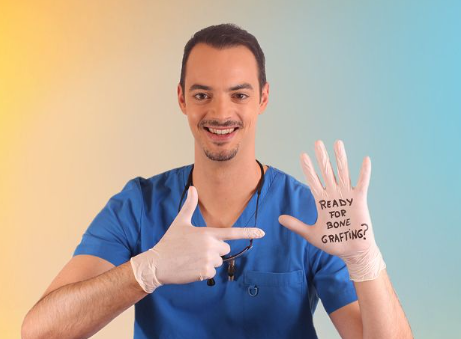
Andoni Jones centra su práctica en Cirugía Oral e Implantología. Ejerce en Madrid. Su formación de base procede de Universidad del País Vasco en 2010.
Hoy trabaja como cirujano/implantólogo en 3D Dental (Irlanda). Antes desarrolló su actividad en MyDental Clinic y Osagest S.L.
La docencia ocupa la otra mitad de su tiempo: imparte clase en Universidad Rey Juan Carlos, Universidad Europea y EDE Posgrados, en programas como Máster de Formación Permanente en Implantología Avanzada, Regeneración Tisular y Rehabilitación Implantosoportada y Máster Universitario en Cirugía e Implantología Bucal Avanzada.
En Doctor&Cols imparte 4 formaciones — entre ellas «Masterclass: Implantes fracasados, ¿y ahora qué?» y «Mentorías: Domina la cirugía avanzada de la mano del Dr. Andoni Jones» — en Madrid - España y Málaga - España y firma 3 publicaciones científicas en revistas como International Journal of Periodontics & Restorative Dentistry y The International Journal of Periodontics & Restorative Dentistry.
Explora su trayectoria
Posgrado en Cirugía Oral Básica y Avanzada
Especialista · Universidad de Ciencias Médicas de Cienfuegos · Cienfuegos, Cuba
Especialización Universitaria Implantología Oral y Microcirugía
Especialista · Universidad del País Vasco · Leioa, España
Grado / Licenciado en Odontología
Grado · Universidad del País Vasco · Leioa, España
3D Dental · Irlanda
MyDental Clinic · Irlanda
Osagest S.L · Guipúzcoa, España
Profesor · Máster de Formación Permanente en Implantología Avanzada, Regeneración Tisular y Rehabilitación Implantosoportada
Universidad Rey Juan Carlos · Madrid, España
Profesor · Máster Universitario en Cirugía e Implantología Bucal Avanzada
Universidad Europea · Madrid, España
Profesor · Especialista en Cirugía Avanzada y Regenerativa
EDE Posgrados · España
19/09/2026 · Madrid - España · Presencial
Cirugía y Periodoncia
17/10/2026 · Málaga - España · Presencial
Cirugía y Periodoncia
Fecha a convenir · Madrid - España · Presencial
Cirugía y Periodoncia
Fecha a convenir · España (itinerante) · Presencial
Cirugía y Periodoncia
International Journal of Periodontics & Restorative Dentistry
Q2 · IF 1.2Autores · Andoni Jones
This case report shows how to place and restore dental implants in just 6 months in a patient requiring vertical and horizontal hard and soft tissue augmentation, including a lateral window sinus elevation. It highlights the utilization of pure autogenous bone, including the sinus elevation, to shorten the reentry time to just 3 months, as well as the subsequent soft tissue grafting during implant placement to avoid a third surgery. After the bone augmentation, the soft tissue thickness was inadequate for implant placement and the mucogingival line was distorted due to flap advancement. Understanding the available hard tissue grafting techniques and biomaterials is essential for proper treatment planning. Incorporating soft tissue management protocols into implant placement surgeries will reduce the number of surgeries and overall treatment time.
The International Journal of Periodontics & Restorative Dentistry
Q3 · IF 1.103Autores · David Chávarri-Prado, Andoni Jones, Esteban Pérez-Pevida, Markel Diéguez-Pereira, Alejandro Estrada-Martínez, Rodrigo Cabezón-Palacios
Coautores Doctor&Cols · Esteban Pérez Pevida, Markel Diéguez Pereira, Alejandro Estrada Martínez, David Chávarri Prado
Sinus floor augmentation is one of the most common approaches to obtain sufficient bone availability for placing implants in cases with severe bone atrophy in the posterior maxilla. Several bone substitutes are indicated for sinus augmentation, but they may achieve different clinical outcomes. This study aims to compare bovine bone mineral (BBM) with freeze-dried bone allograft (FDBA) in a two-stage lateral window sinus grafting approach. Twenty patients received a lateral window sinus elevation with either FDBA or BBM. Postoperative graft height was measured with CBCT. Implants were placed 6 months later, at which time biopsy samples were taken for histologic analysis and new CBCT scans were performed to measure graft height. The mean height reduction at 6 months was 20.27% ± 4.94% for FDBA samples and 5.36% ± 2.41% for BBM samples. The histologic analysis revealed a mean ratio of newly formed bone of 43.70% ± 5.29% for the FDBA group and 38.11% ± 4.03% for the BBM group. The FDBA group also showed a higher amount of residual biomaterial (17.25% ± 10.10%) and connective tissue (14.63% ± 4.38%) compared to the BBM group (15.53% ± 5.42% and 13.11% ± 4.42%, respectively). The differences between groups were statistically significant for the height reduction and newly formed bone (P ≤ .05) but not for the amounts of residual biomaterial and nonmineralized connective tissue (P ≥ .05). Six months after performing a lateral window sinus elevation, the percentage of newly formed bone was significantly higher when using FDBA than when using BBM, although the graft height reduction was also significantly higher for the FDBA group.
The International Journal of Esthetic Dentistry
Q2 · IF 1.9Autores · Jones A
Los implantes en el área estética suponen un reto, especialmente cuando el tejido duro y blando son deficientes al inicio del procedimiento. Existen múltiples técnicas de injerto, cada una con sus fortalezas y limitaciones. El presente artículo describe el tratamiento de un incisivo central maxilar con deficiencia ósea tras la extracción de un diente anquilosado. Se utilizó una lámina ósea palatina para reconstruir la pared vestibular ausente. Tres meses después, se colocó el implante y simultáneamente se aumentó el tejido blando con un injerto de tejido conectivo. El caso se restauró con éxito y un resultado estético satisfactorio, destacando los períodos de curación más cortos y la calidad óptima de los tejidos obtenidos.
Cirugía Oral e Implantología
Ávila · España
Cirugía Oral e Implantología
Las Palmas · España
Cirugía Oral e Implantología
Chile
Cirugía Oral e Implantología
Barcelona · España
Cirugía Oral e Implantología
Almería · España
Cirugía Oral e Implantología
Madrid · España