Cirugía Oral e Implantología
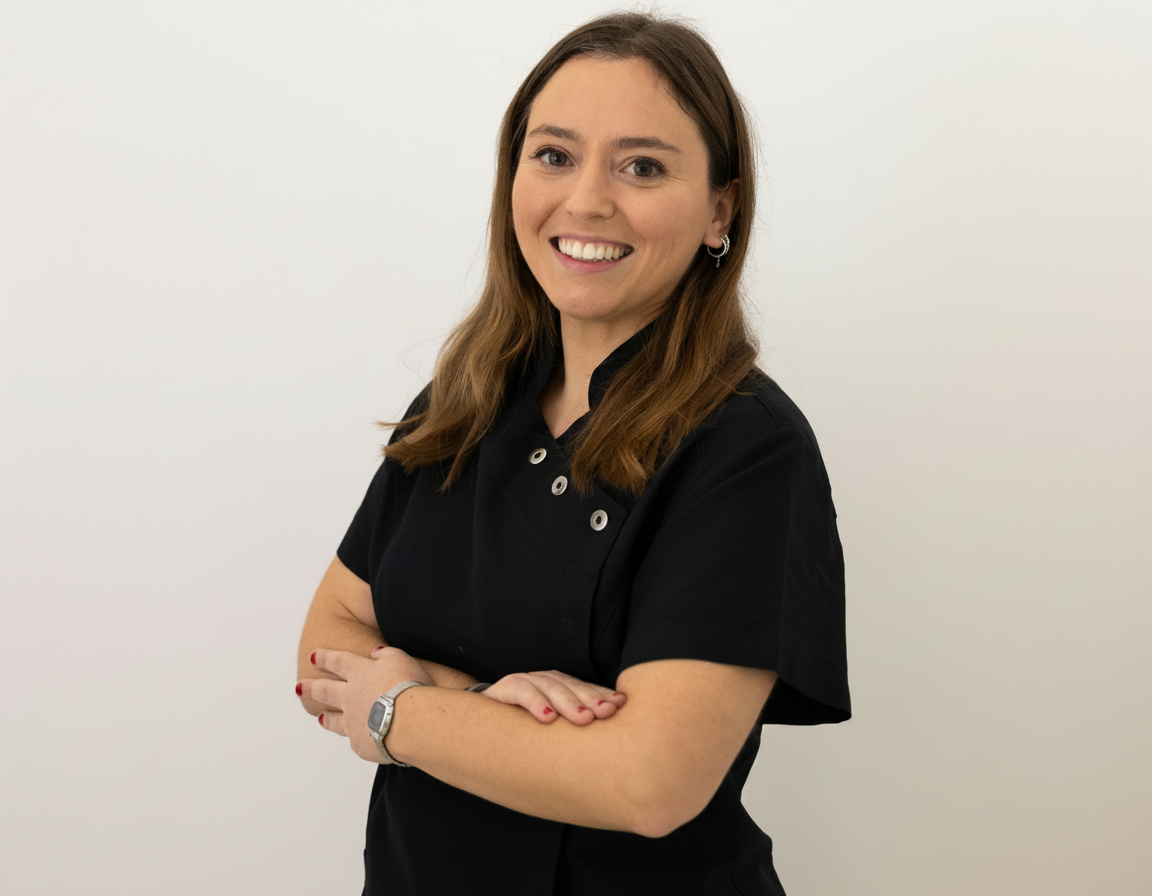
Maria Josep Albert López centra su práctica en Cirugía Oral e Implantología, y trabaja de forma específica la periodoncia y cirugía mucogingival. Ejerce en Valencia. Se formó como odontóloga en Universidad Católica de Valencia en 2015.
Su recorrido formativo explica el resto: ha orientado su formación de posgrado hacia ortodoncia, periodoncia y osteointegración y ha completado estudios de gestión clínica. Su título de posgrado más reciente es el Máster en Ortodoncia Clínica (Universidad Isabel I, 2023). Ha pasado por Universidad Isabel I y Universidad Católica de Valencia.
Actualmente ejerce como periodoncista en Clínica dental Font De La Rosa, Clínica dental Dentisana Valencia Ruzafa y Clínica dental Dr. Luis Martorell en la provincia de Valencia. Antes desarrolló su actividad en Clínica dental Dentistas Grau & Colaboradores y Clínica dental Blanch.
Compagina la clínica con la docencia en Universidad Católica de Valencia, en programas como Grado / Licenciado en Odontología y Máster de Formación Permanente en Periodoncia y Osteointegración.
Dentro de Doctor&Cols imparte 3 formaciones — entre ellas «Periodoncia fase básica paso a paso» y «Periodoncia avanzada» — en Valencia - España y España y firma 3 publicaciones científicas en revistas como Clinical Oral Investigations y Acta Scientific Dental Sciences.
Explora su trayectoria
Máster en Ortodoncia Clínica
Máster · Universidad Isabel I · Burgos, España
Máster de Formación Permanente en Periodoncia y Osteointegración
Máster · Universidad Católica de Valencia · Valencia, España
Certificado en Dirección de Instalaciones de Radiodiagnóstico General
Otro · Universidad Católica de Valencia · Valencia, España
Grado / Licenciado en Odontología
Grado · Universidad Católica de Valencia · Valencia, España
Clínica dental Albert y Barber · Valencia, España
Clínica dental Font De La Rosa · Valencia, España
Clínica dental Dentisana Valencia Ruzafa · Valencia, España
Clínica dental Dr. Luis Martorell · Valencia, España
Clínica dental Carralero · Valencia, España
Clínica dental Blanch · Valencia, España
Clínica dental Nacha Vázquez · Valencia, España
Clínica dental Soldents · Valencia, España
Adeslas Castellón · Castellón, España
Clínica dental Dentistas Grau & Colaboradores · Valencia, España
Profesor asociado · Grado / Licenciado en Odontología
Universidad Católica de Valencia · Valencia, España
Profesor coordinador · Máster de Formación Permanente en Periodoncia y Osteointegración
Universidad Católica de Valencia · Valencia, España
Fecha a convenir · Valencia - España · Presencial
Cirugía y Periodoncia · Periodoncia y Cirugía Mucogingival
Fecha a convenir · Valencia - España · Presencial
Cirugía y Periodoncia · Periodoncia y Cirugía Mucogingival
Fecha a convenir · España · Presencial
Armonización Orofacial · Cirugía y Periodoncia
Clinical Oral Investigations
★ Alto impacto · Q1 · IF 3.846Autores · Quintas-Hijós J, Pérez-Pevida E, Albert-López MJ
Coautores Doctor&Cols · Jacobo Quintas Hijós, Esteban Pérez Pevida
OBJECTIVES: To determine the most effective combination of abutment height and timing of placement in reducing marginal bone loss (MBL). MATERIALS AND METHODS: 54 patients received at least one single screw-retained crown on an implant replacing a posterior tooth (60 implants). Implants were divided into six groups based on intermediate abutment height (1.5 mm, 2 mm, 3 mm) and timing of placement (immediate: surgery 1; delayed: surgery 2): Group A3I (height 3, surgery 1), Group A2I (height 2, surgery 1), Group A15I (height 1.5, surgery 1), Group A3D (height 3, surgery 2), Group A2D (height 2, surgery 2), Group A15D (height 1.5, surgery 2). Mesial and distal linear radiographic measurements were taken at five follow-up points: implant surgery, crown placement (T1), and 3 (T2), 6 (T3), and 12 months after loading (T4). Partial and total MBL were compared between groups. RESULTS: After 12 months, the lowest MBL was found in groups A3I (0.13 ± 0.11 mm) and A2I (0.24 ± 0.11 mm), with no statistical difference between them. Groups A15I (0.70 ± 0.12 mm), A3D (0.66 ± 0.11 mm), A2D (0.62 ± 0.12 mm), and A15D (0.78 ± 0.11 mm) showed significantly higher MBL than groups 1 and 2, with no statistical difference among them. CONCLUSIONS: Immediate abutments of 2-3 mm resulted in lower MBL compared to 1.5 mm immediate abutments or any delayed abutments. CLINICAL RELEVANCE: This study provides data on the optimal combination of intermediate abutment height and placement timing in preventing MBL. CLINICAL TRIAL REGISTRATION: Clinical trial registration number: NCT06667531. link: https://clinicaltrials.gov/study/NCT06667531 .
Acta Scientific Dental Sciences
Autores · Albert-López MJ, Pallarés-Serrano AI, Bardají JA
This study was aimed to investigate chemical preactivated thiomers for their potential use in mucosal drug delivery. Thiomers--thiolated polymers--are mucoadhesive polymers with sulfhydryl group-bearing side chains. Thiomers are synthesized by covalent attachment of low molecular mass compounds bearing sulfhydryl group to the polymeric backbone of well-established polymers. Hyaluronic acid-cysteine ethyl ester-mercaptonicotinamide conjugates (HA-CYS-MNA) were synthesized by the oxidative S-S coupling of HA-CYS with 6-MNA. Conjugates were compressed into test discs to investigate cohesive properties, cytotoxicity assays, and mucoadhesion studies. Because of the immobilization of MNA, the HA-CYS-MNA conjugates exhibit comparatively higher swelling properties and cohesive properties corresponding unmodified HA. On the rotating cylinder, discs based on HA-CYS-MNA conjugates displayed fourfold improved mucoadhesion time compared with thiolated polymers. Tensile study results were found in good agreement with rotating cylinder results. Moreover, preactivated thiomers showed higher stability. All polymers were found nontoxic over Caco-2 cells. On the basis of achieved results, the preactivated thiomeric therapeutic agent seems to represent a promising generation of mucoadhesive polymers that are safe to use for a prolonged residence time to target the mucosa requested for intraoral application.
Scientific Archives of Dental Sciences
Autores · Pallarés-Serrano AI, Albert-López MJ, Javier A Bardají
Tracheobronchial foreign body aspiration (FBA) is potentially life-threatening. In adults, delayed diagnosis may occur because symptoms are nonspecific and organic foreign bodies can be radiolucent, leading to recurrent infection, granulation tissue, and surgical resection. A 46-year-old Arab man with hypertrophic cardiomyopathy and hypertension presented with fever, productive cough, and grade II dyspnea 15 months after accidental pea aspiration. Chest computed tomography (CT) demonstrated a focal basal right lower-lobe mass-like consolidation, corresponding to the surgically treated basal segments, without a definite radiopaque intraluminal foreign body. Flexible bronchoscopy achieved only partial removal, and histopathology confirmed plant material with nonspecific chronic inflammation. Despite conservative treatment, he deteriorated with foul-smelling purulent sputum and persistent inflammation. Because of failed conservative/endoscopic management, bronchial strictures, and vegetative inflammatory lesions, he underwent right lower-lobe basal segmentectomy via thoracotomy. Surgery revealed marked induration, consolidation, and a purulent collection. Final pathology showed chronic suppurative inflammation with lymphoid follicles and purulent material, plus a 1.3-cm sclerosing nodule with papillary formations; immunohistochemical evaluation was requested to further exclude an associated neoplastic process. At 2-week follow-up, he improved clinically, and chest radiography showed no residual or recurrent focal mass-like consolidation. Adult FBA may mimic malignancy or chronic infection. CT is essential for identifying secondary postobstructive changes, although the foreign body may not be directly visible. Delayed presentation increases the risk of granulation, infection, and failed bronchoscopic retrieval. Delayed organic FBA should be considered in persistent focal lower-lobe consolidation; early CT and bronchoscopy may prevent complications and surgery.
Cirugía Oral e Implantología
Valencia · España
Cirugía Oral e Implantología
Madrid · España
Cirugía Oral e Implantología
Madrid · España
Cirugía Oral e Implantología
Santa Cruz de Tenerife · España
Cirugía Oral e Implantología
Cádiz · España
Cirugía Oral e Implantología
Madrid · España