Cirugía Oral e Implantología
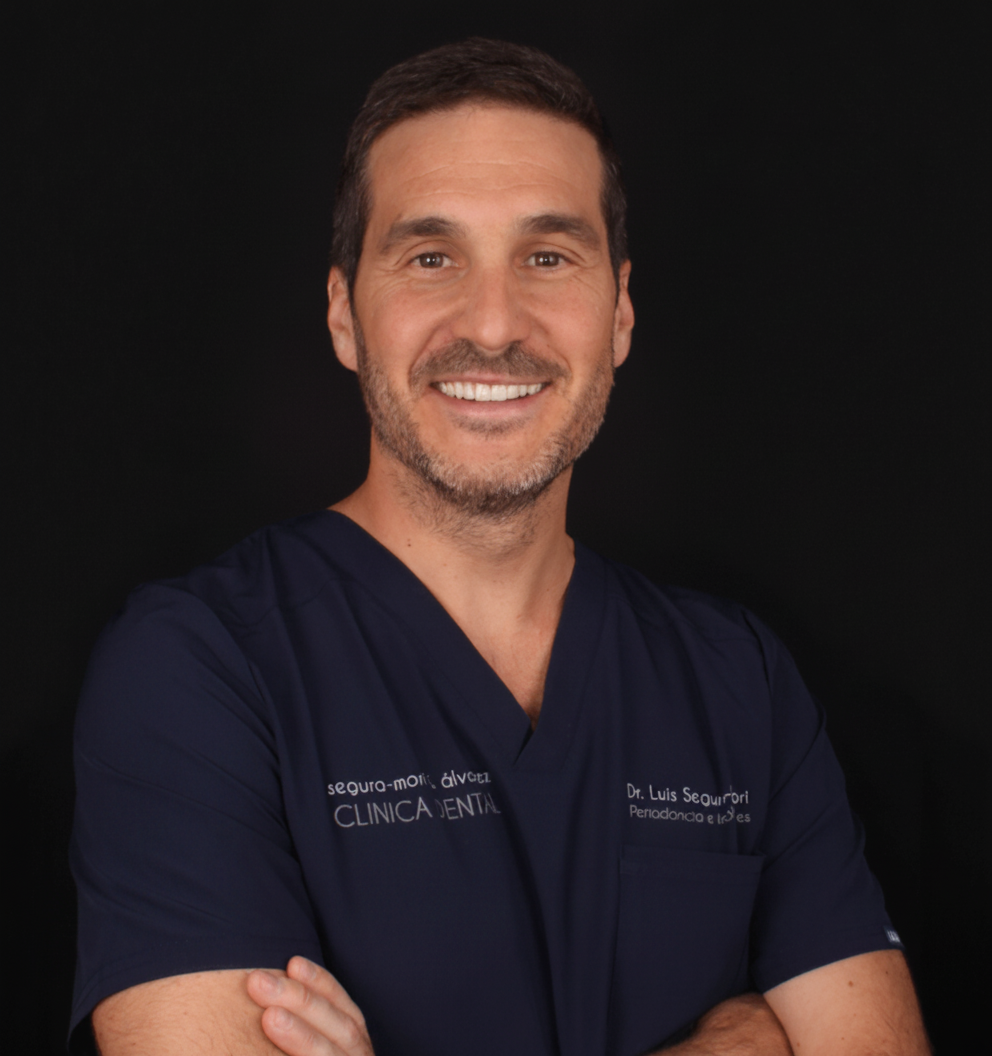
Luis Segura-Mori es odontólogo con dedicación a Cirugía Oral e Implantología, con la periodoncia y cirugía mucogingival como eje de su trabajo. Su actividad clínica se desarrolla en Madrid. Cursó sus estudios de Odontología en Universidad Complutense de Madrid en 2003.
Con el tiempo, ha sumado formación específica en periodoncia y regeneración y ha llegado al nivel de doctorado. El último de esos programas fue el Doctorado en Odontología, en Universidad de Oviedo (2006).
Su práctica diaria se desarrolla en Clínica dental Segura-Mori & Álvarez, como director médico (Madrid, España).
Además de la clínica, mantiene actividad de docencia en McGann Postgraduate School of Dentistry y Universidad Complutense de Madrid, en programas como ología y tecnologías.
Su aportación al colectivo: firma 3 publicaciones científicas en revistas como Annals of Anatomy - Anatomischer Anzeiger y Odontology.
Explora su trayectoria
Microcirugía, Periodoncia e Implantología
Curso · Hürzeler/Zuhr Education Center · Múnich, Alemania
Programa de Regeneración Ósea Avanzada
Curso · Urban Regeneration Institute of Budapest · Budapest, Hungría
Doctorado en Odontología
Doctorado · Universidad de Oviedo · Oviedo, España
Máster en Rehabilitación Oral
Máster · Universidad de Oviedo · Oviedo, España
Grado/Licenciado en Odontología
Grado · Universidad Complutense de Madrid · Madrid, España
Clínica dental Segura-Mori & Álvarez · Madrid, España
Profesor ayudante · ología
McGann Postgraduate School of Dentistry · Estados Unidos
Profesor · tecnologías
Universidad Complutense de Madrid · Madrid, España
Formaciones ya celebradas que imparten o han impartido.
17/09/2026 a 28/11/2026
Annals of Anatomy - Anatomischer Anzeiger
Q3 · IF 1.476Autores · Luis Miguel Sáez-Alcaide, Francisco González Fernández-Tresguerres, Jorge Cortés‐Bretón Brinkmann, Luis Segura-Mori, Óscar Iglesias‐Velázquez, Fabián Pérez‐González, Rosa María López‐Pintor, Jesús Torres
Alveolar bone resorption after dental extraction frequently leads to situations in which long-term function and esthetic success of rehabilitations with dental implants is a challenge. Socket shield has been described as an alternative technique to maintain the alveolar ridge when placing immediate implants. The aim of this review is to evaluate the medium- and long-term clinical outcomes of the socket shield technique in human studies. This review was conducted according to PRISMA guidelines. An electronic search was conducted in four databases: (1) The National Library of Medicine (MEDLINE/PubMed) via Ovid; (2) Web of Science (WOS); (3) SCOPUS; and (4) Cochrane Central Register of Controlled Trials (CENTRAL). The Cochrane Collaboration tool, the Newcastle-Ottawa Quality Assessment Scale and The Joanna Briggs Institute Critical Appraisal tool were used to assess the quality of evidence in the studies reviewed. Six articles were included in this review. The studies analysed showed lower rates of horizontal and vertical alveolar bone resorption, better maintenance of the buccal plate, less marginal bone loss and better esthetic results than simple placement of immediate implants. However, a lack of homogeneity was found in evaluation methods of the different outcomes, surgical procedures and prosthetic management. Based on the results of this review, it is possible to suggest that socket shield technique could be a good alternative in terms of alveolar bone maintenance, marginal bone stability and aesthetic outcomes in immediate implant treatment. However, it is not possible to recommend this technique as an alternative treatment with the same long-terms predictability as conventional immediate implants.
Odontology
Q2 · IF 1.947Autores · Ángel Álvarez‐Arenal, Luis Segura-Mori, Ignacio González-González, Hector deLlanos‐Lanchares, Fernando Sánchez Lasheras, Joseba Ellacuria-Echevarria
A 3D finite element analysis was conducted to evaluate and compare the stress distribution in the peri-implant bone (transitional cortical and trabecular bone) of one single implant-supported crown with platform switching and another without platform switching, under a vertical and an oblique load. Two models were created, simulating an osseointegrated implant (4 × 13 mm, platform 4.1 mm) embedded in the jaw bone. One model simulated a 4.1-mm diameter abutment connection (conventional model) and the other a 3.8-mm diameter abutment connection (platform-switching model). A crown with a Co-Cr alloy framework and feldspathic porcelain veneering was applied over the titanium abutment. Static, vertical and oblique loads (0°, 15°, 30°, 45°) with a maximum value of 150 N were applied to the crown. For any inclination of the applied load, the stress values in the transitional cortical bone were lower in the platform-switching model than in the conventional model. However, the stress in the transitional trabecular bone was higher in the platform-switching model than in the conventional model. Stress values increased when the load was more oblique at the transitional cortical bone in both models and was slightly reduced at the transitional trabecular bone of the conventional model. The platform-switching technique reduces the stress at the transitional cortical bone. In both models, this stress gradually increases as the load becomes more inclined. The transitional trabecular bone shows lower stress values than the transitional cortical bone. The location of stress is similar in both models.
The International Journal of Oral & Maxillofacial Implants
Q3 · IF 1.088Autores · Ángel Álvarez‐Arenal, Luis Segura-Mori, Ignacio González-González, Ángel Gago
PURPOSE: Three-dimensional finite element analysis was conducted to evaluate and compare the stress distribution in the abutment and retention screw of implant-supported single crowns with platform switching and with a conventional platform under vertical and oblique loading. MATERIALS AND METHODS: Two finite element models were created simulating an osseointegrated implant (4 × 10 mm, platform 4.1 mm) embedded in jawbone. One model simulated a 4-mm-diameter abutment connection (conventional model) and the other represented a 3.8-mm-diameter abutment connection (platform-switched model). A crown with a cobalt-chromium framework and feldspathic porcelain veneering was applied to the titanium abutment. Static vertical and oblique loads were applied to the crown, with a maximum load of 150 N. RESULTS: In both models, the highest stress values occurred in the abutment during vertical and oblique loading. Nevertheless, the von Mises stresses in the abutment and the retention screw were lower in the platform-switched model than in the conventional model. During axial loading, the abutment and screw supported slightly less stress in the conventional model than in the platform-switched model. Increases in the angle of force application caused a progressive increase in stresses in the abutment and screw in both models. The maximum stress was distributed at the margin and transgingival area of the abutment and on two-thirds of the flat area and the first threads of the retention screw in both models. CONCLUSIONS: Platform switching reduced the stress values on the abutment and retention screw of a single-unit prosthesis during oblique loading. Regardless of whether platform switching was employed, the stress on the abutment and screw gradually increased as the loading direction changed from vertical to 45 degrees oblique. The locations and distributions of stresses were similar in both models.
Cirugía Oral e Implantología
Sevilla · España
Cirugía Oral e Implantología
Murcia · España
Cirugía Oral e Implantología
Cádiz · España
Cirugía Oral e Implantología
Zaragoza · España
Cirugía Oral e Implantología
Madrid · España
Cirugía Oral e Implantología
Madrid · España