Cirugía Oral e Implantología
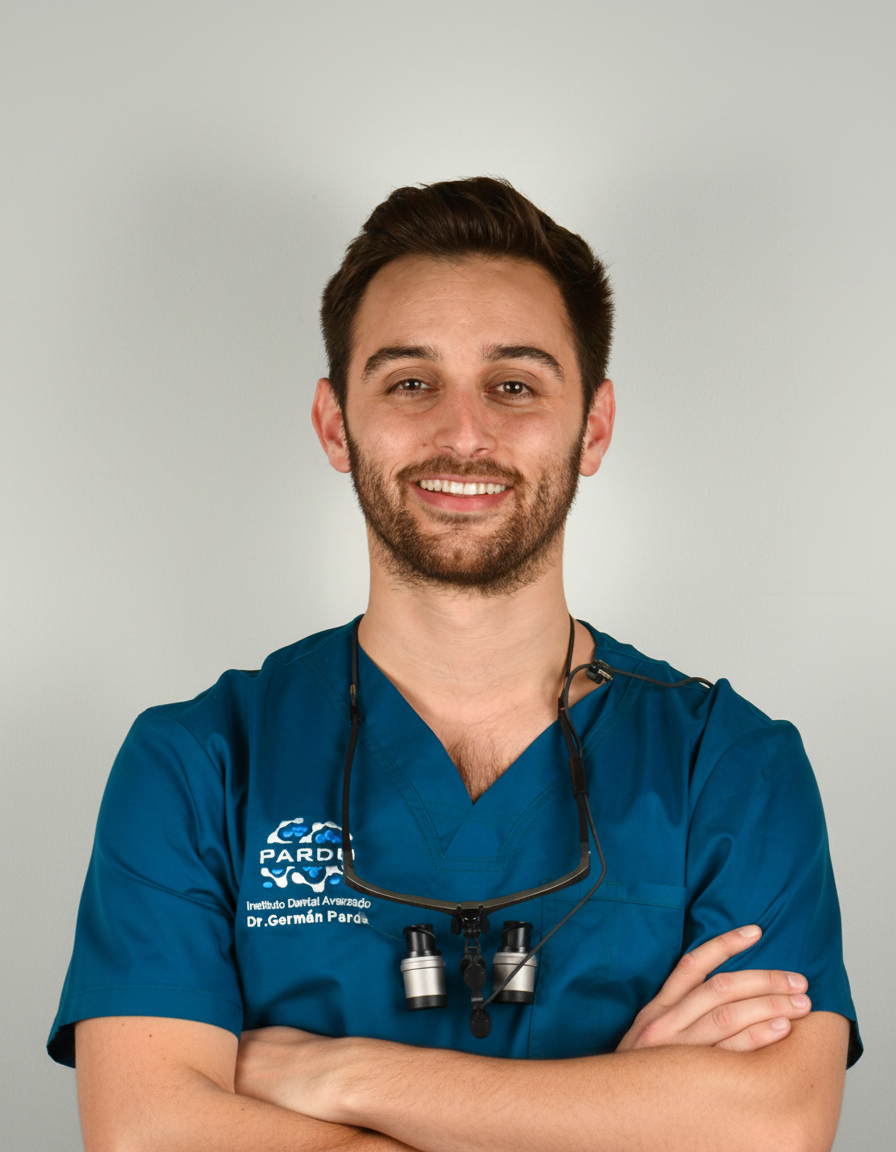
Germán Pardo Perl desarrolla su actividad profesional en el ámbito de Cirugía Oral e Implantología, con especial atención a periodoncia y cirugía mucogingival. Su actividad clínica se desarrolla en Málaga. Su formación de base procede de Universidad de Granada en 2018.
A lo largo de su trayectoria, ha profundizado en periodoncia y ha llegado al nivel de doctorado. El último de esos programas fue el Máster Universitario en Periodoncia e Implantes, en Universitat Internacional de Catalunya (2023). Ha pasado por Universitat Internacional de Catalunya y Universidad de Granada.
Hoy trabaja como director médico en Instituto Dental Avanzado Pardo (Málaga, España).
La docencia ocupa la otra mitad de su tiempo: imparte clase en Universitat Internacional de Catalunya, en programas como Máster Universitario en Periodoncia e Implantes.
En Doctor&Cols firma una publicación científica en revistas como Journal of Clinical Periodontology.
Explora su trayectoria
Máster Universitario en Periodoncia e Implantes
Máster · Universitat Internacional de Catalunya · Barcelona, España
Máster Universitario en Ciencias Odontológicas
Máster · Universidad de Granada · Granada, España
Doctorado en Odontología
Doctorado · Universitat Internacional de Catalunya · Barcelona, España
Grado / Licenciado en Odontología
Grado · Universidad de Granada · Granada, España
Instituto Dental Avanzado Pardo · Málaga, España
Profesor · Máster Universitario en Periodoncia e Implantes
Universitat Internacional de Catalunya · Barcelona, España
Journal of Clinical Periodontology
★ Alto impacto · Q1 · IF 5.8Autores · Muñoz M, Pardo-Perl GE, Vilarrasa J, Babiano-Nodal A, et al.
Aim: To evaluate bone level changes in implants with 1-mm- or 3-mm-high abutments over a 7-year period and to investigate the role of abutment height upon peri-implant status. Materials and Methods: Two-piece implants were placed 1.5 mm subcrestally with either 1-mm (control) or 3-mm (test) high definitive abutments. Marginal bone level change from the first to seventh year was the primary outcome. Peri-implant status and other patient and peri-implant clinical variables (smoking, peri-implant maintenance therapy compliance, interproximal hygiene, vertical soft tissue thickness and keratinised mucosa width) were also assessed. Results: After 7 years, 37 subjects (63 implants) were analysed: 17 subjects with 32 implants in the 1-mm abutment group, and 20 subjects with 31 implants in the 3-mm abutment group. Significant differences in marginal bone level changes were observed at 7 years. The 3-mm abutment group showed smaller changes compared to the 1-mm abutment group at mesial sites (−0.27 ± 1.32 mm vs. −0.42 ± 0.50 mm, respectively) and distal sites (−0.33 ± 1.39 mm vs. −0.35 ± 0.38 mm), with both differences being statistically significant (p < 0.001). In the control group, 18 implants (54.6%) presented peri-implant mucositis and 6 implants (18.2%) showed peri-implantitis. In the test group, 23 implants (74.2%) presented peri-implant mucositis and 1 implant (3.2%) showed peri-implantitis. No statistically significant differences were found (p = 0.158). Conclusions: Subcrestally inserted implants with 3-mm definitive abutments experienced minimal bone loss over long-term follow-up compared to 1-mm abutments. However, since the differences were not statistically significant, no conclusions could be drawn on the protective effect against peri-implantitis.
Cirugía Oral e Implantología
Valencia · España
Cirugía Oral e Implantología
Palencia · España
Cirugía Oral e Implantología
Madrid · España
Cirugía Oral e Implantología
Santa Cruz de Tenerife · España
Cirugía Oral e Implantología
Madrid · España
Cirugía Oral e Implantología
Barcelona · España