Rehabilitación Oral y Estética Dental
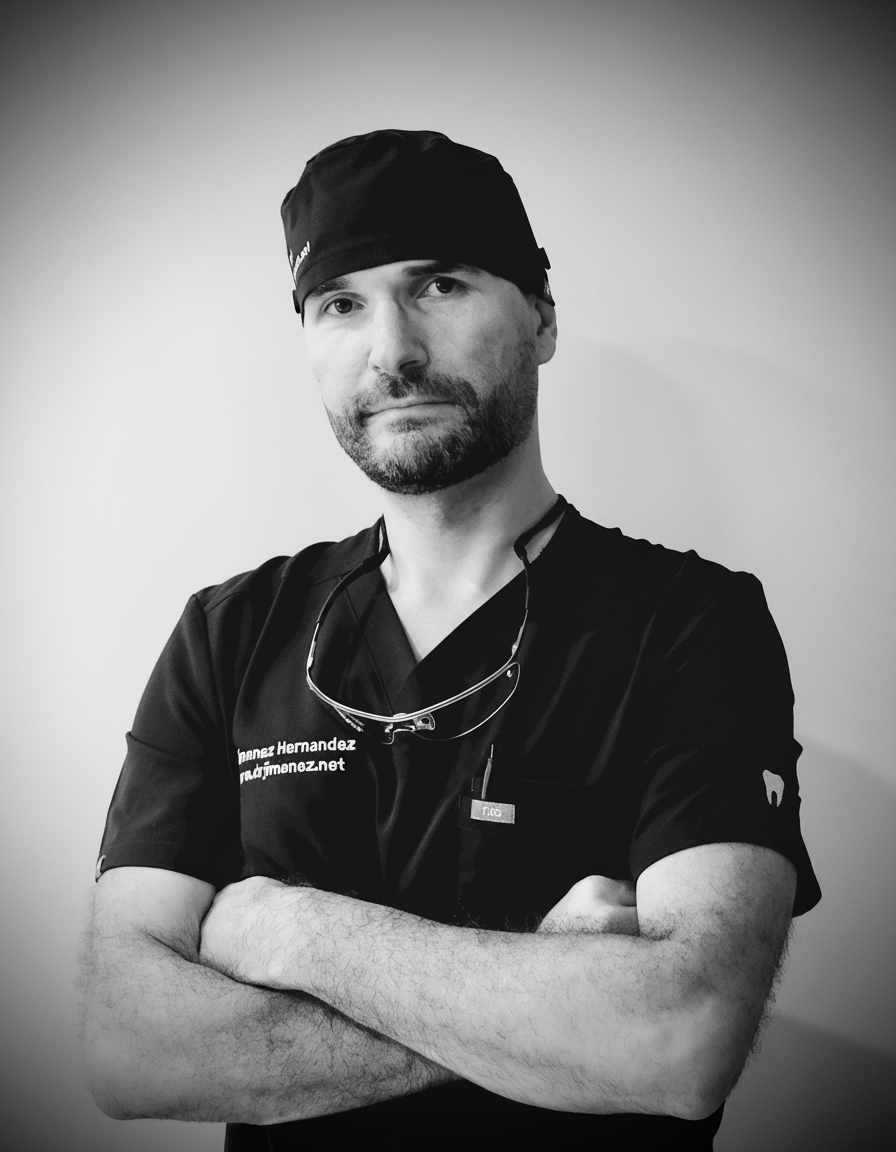
La práctica de Rubén Jiménez Hernández gira en torno a Rehabilitación Oral y Estética Dental, y trabaja de forma específica la rehabilitación implanto-soportada. Ejerce en Murcia. Se formó como odontólogo en Universidad de Murcia en 2013.
Su recorrido formativo explica el resto: ha orientado su formación de posgrado hacia implantología, periodoncia y cirugía oral. Su título de posgrado más reciente es el Máster internacional europeo de especialización universitaria en Odontología Implantológica Avanzada (European Association for Osseointegration (EAO), 2026). Ha pasado por European Association for Osseointegration (EAO) y New York University.
Actualmente ejerce como cirujano/implantólogo en Clínica dental Molident y Grupo Helvetia: Caser dental en la provincia de Murcia.
Compagina la clínica con la docencia en Universidad Católica San Antonio de Murcia (UCAM), en programas como Grado en Odontología.
Dentro de Doctor&Cols imparte una formación — entre ellas «Cirugía de implantes y flujo digital: integración clínica actual» — en Salón de actos · Colegio Oficial de Dentistas de la Región de Murcia (C/ María Zambrano, 4, 30007 Murcia) y firma 2 publicaciones científicas en revistas como Case Reports in Dentistry y J Clin Exp Dent. 2026;18(4):e569-81.
Explora su trayectoria
Máster internacional europeo de especialización universitaria en Odontología Implantológica Avanzada
Máster · European Association for Osseointegration (EAO) · Bruselas, Bélgica
Mastership Universitario Internacional de Especialización en Implantología y Periodoncia Oral Avanzadas
Máster · New York University · Nueva York, Estados Unidos
Posgrado modular de especialización en Implantología y Cirugía Guiada Oral
Experto · IESO · España
Grado / Licenciado en Odontología
Grado · Universidad de Murcia · Murcia, España
Clínica dental Molident · Murcia, España
Grupo Helvetia: Caser dental · Murcia, España
Profesor asociado · Grado en Odontología
Universidad Católica San Antonio de Murcia (UCAM) · Murcia, España
Viernes 20 de noviembre de 2026 · 9:30–19:00 · Salón de actos · Colegio Oficial de Dentistas de la Región de Murcia (C/ María Zambrano, 4, 30007 Murcia) · Presencial
Cirugía Oral e Implantología
Case Reports in Dentistry
Autores · Jiménez Hernández R
Bar-retained maxillary overdentures supported by four implants have shown favorable survival and consistently positive patient-reported outcomes, particularly when careful prosthetic planning and high primary stability are achieved. The case presented here illustrates the clinical application of this treatment approach as part of a full mouth rehabilitation. A 64-year-old male presented with poor esthetics and function due to multiple missing teeth in both arches and nonrestorable maxillary teeth and mandibular molars. Although the mandibular arch could be restored with a combination of fixed crowns and a removable partial denture, the remaining maxillary teeth were all deemed to have a poor prognosis. In shared decision making, the patient opted for removal of these maxillary teeth and replacement with an implant-supported bar overdenture. Following minimally traumatic extraction and partial grafting of sockets using a xenogeneic bone substitute, four bone-level implants were placed immediately in the canine-premolar positions (13, 15, 23, and 25) according to a prosthetically driven three-dimensional plan, achieving insertion torques of 40-45 Ncm. After a 5-month uneventful osseointegration period and minimally invasive uncovering surgery, straight multiunit abutments and an Ackermann-type bar were used to support a bar-retained maxillary overdenture with bilateral balanced occlusion. At the 4- and 7-month follow-up visits, peri-implant tissues were healthy, the implants and bar remained stable, and no biological complications were detected. The patient reported improved comfort, chewing ability, and esthetics.
J Clin Exp Dent. 2026;18(4):e569-81
Q3 · IF 1.312Autores · Jiménez Hernández R
Background: Wide-thread dental implants have been proposed to enhance primary stability and marginal bone preservation in immediate implant placement protocols, particularly in low-density bone. This systematic review aimed to evaluate the influence of wide-thread implant macrogeometry on primary stability, marginal bone loss, and survival outcomes in immediate implant placement. Material and Methods: A systematic electronic search was performed in PubMed (MEDLINE), complemented by manual screening of reference lists and forward and backward citation tracking, to identify studies published between January 2007 and August 2025. Clinical studies, in vitro experiments, finite element analyses, and reviews assessing the effect of implant macrogeometry, especially wide-thread configurations, on insertion torque, implant stability quotient (ISQ), marginal bone loss (MBL), and survival in immediate placement were included. Studies without biomechanical relevance, non-English publications, case reports, and those lacking quantitative stability or bone data were excluded. Results: A total of 36 records were initially identified, and 25 studies met the inclusion criteria. Increased thread depth, wider or more aggressive threads, and tapered implant bodies generally improved insertion torque and ISQ values, particularly in D3–D4 bone and post-extraction sockets. Clinical investigations reported high survival rates for immediately placed implants with optimized macrogeometry, while MBL typically remained within clinically acceptable limits when adequate primary stability and appropriate loading protocols were achieved. However, small sample sizes, short follow-up periods, heterogeneity among implant systems, and non-standardized outcome reporting limited the possibility of robust quantitative comparisons. Conclusions: Wide-thread implant macrogeometry appears to enhance primary stability in immediate placement and supports favorable short- to medium-term survival and marginal bone behavior when combined with careful case selection and controlled loading. Further well-designed prospective randomized studies with long-term follow-up are needed to determine whether these biomechanical advantages translate into superior long-term clinical outcomes.
Rehabilitación Oral y Estética Dental
Zaragoza · España
Rehabilitación Oral y Estética Dental
Illes Balears · España
Rehabilitación Oral y Estética Dental
México
Rehabilitación Oral y Estética Dental
Pontevedra · España
Rehabilitación Oral y Estética Dental
Murcia · España
Rehabilitación Oral y Estética Dental
Málaga · España